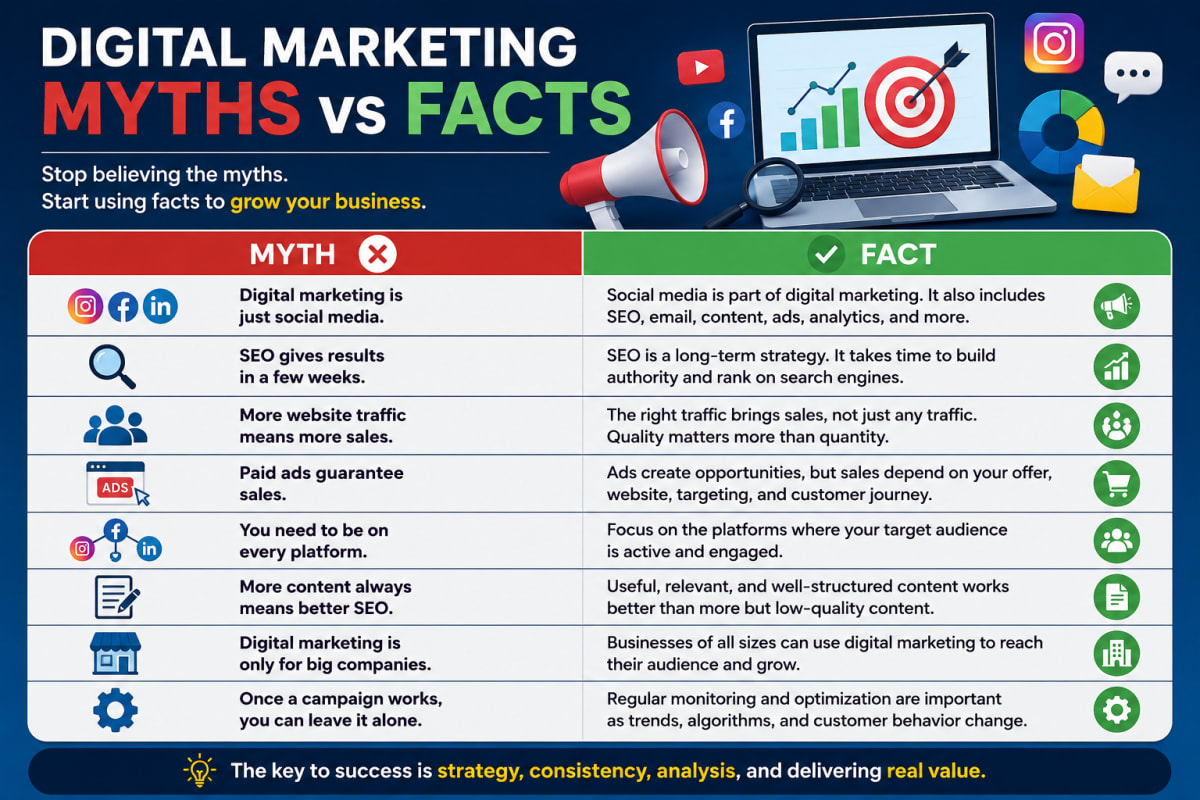
Caption: Digital Marketing Myths vs Facts: What Businesses Need to Know • Image rights reserved by Annuity Outlook.
Digital marketing has become an important part of how businesses attract customers, build visibility and generate sales. Yet, despite its growing importance, the industry is surrounded by assumptions that can lead businesses in the wrong direction.
Some believe that posting regularly on social media is enough to grow a business. Others expect SEO to deliver results within a few weeks or assume that running paid advertisements automatically guarantees sales.
The reality is more complicated.
Digital marketing works when different channels, strategies and business goals come together. Here are some of the most common digital marketing myths and the facts businesses should understand before investing their time and money.
Myth 1: Digital Marketing Means Social Media
Fact: Social media is only one part of digital marketing.
Platforms such as Instagram, Facebook, LinkedIn and YouTube can help businesses build an audience, but digital marketing covers much more. Search engine optimisation (SEO), Google Ads, email marketing, content marketing, influencer marketing, online reputation management and conversion optimisation are all part of the larger digital marketing ecosystem.
A business selling professional services, for example, may find that Google search brings more qualified leads than social media. Another brand may perform better through Instagram or YouTube.
The right strategy depends on the business, its customers and the buying journey.
Myth 2: SEO Gives Results in a Few Weeks
Fact: SEO is usually a long-term marketing strategy.
Search engine optimisation involves improving website structure, content, technical performance, keyword targeting, internal linking and authority. Search engines need time to crawl, understand and evaluate changes.
Dany is a business journalist with Annuity Outlook Magazine, with over 16 years of experience across print, digital, and wires. He covers business, technology, policy, and corporate developments, with a focus on in-depth reporting and analysis. Over the years, he has worked across multiple editorial platforms. Skilled in content creation, editing, proofreading, and overseeing print layouts, his career spans multiple editorial platforms.
A new website may take months to establish meaningful organic visibility, particularly when competing for highly competitive keywords.
That does not mean SEO is ineffective. In fact, strong organic rankings can become a valuable source of consistent traffic over time. Businesses should approach SEO as an investment rather than a quick marketing campaign.
Myth 3: More Website Traffic Means More Sales
Fact: Traffic is useful only when it reaches the right audience.
A website can receive thousands of visitors and still generate very few enquiries or sales. The reason may be poor targeting, irrelevant keywords, weak landing pages, confusing navigation or a lack of trust.
Successful digital marketing focuses on qualified traffic, not traffic numbers alone.
A smaller number of visitors who are genuinely interested in a product or service can be far more valuable than a large audience with little purchase intent.
Myth 4: Paid Ads Guarantee Sales
Fact: Advertising creates opportunities, not guaranteed conversions.
Google Ads, Meta Ads and other paid advertising platforms can quickly put a business in front of potential customers. But an advertisement cannot compensate for a weak product, poor offer or ineffective landing page.
Campaign performance depends on several factors, including audience targeting, creative quality, pricing, messaging, website experience and follow-up.
A successful paid advertising campaign therefore requires continuous testing. Businesses often need to experiment with different headlines, creatives, audiences and offers before finding a combination that performs consistently.
Myth 5: You Need to Be on Every Social Media Platform
Fact: Being everywhere can be less effective than being relevant somewhere.
Managing multiple platforms requires time, content and resources. A business does not necessarily need an account on every major social network.
Instead, companies should identify where their target customers actually spend time.
A B2B technology company may benefit more from LinkedIn than from spending heavily on a platform where its potential buyers are less active. Similarly, a visual consumer brand may find Instagram and YouTube more valuable.
The objective should be meaningful reach, not simply a large number of social media profiles.
Myth 6: More Content Always Means Better SEO
Fact: Useful content matters more than publishing volume.
Publishing ten weak articles will not necessarily outperform publishing two well-researched pieces that genuinely answer what customers are searching for.
Search-focused content should address real questions, demonstrate expertise and provide useful information. It should also have a clear purpose within the website's overall content strategy.
Keyword stuffing and repetitive articles can make content difficult to read and may do little to establish long-term search visibility.
For businesses, the better approach is to create content around topics that match customer needs and business objectives.
Myth 7: Digital Marketing Is Only for Large Companies
Fact: Small businesses can benefit significantly from digital channels.
A local business can use Google Business Profile, local SEO, social media and targeted advertising to reach customers in its area. A small online business can use content, search and paid campaigns to compete for niche audiences.
Digital platforms have made it possible for businesses of different sizes to reach specific customer groups without relying exclusively on traditional advertising.
The key is not the size of the marketing budget but how effectively that budget is planned and measured.
Myth 8: Once a Campaign Works, You Can Leave It Alone
Fact: Digital marketing requires regular monitoring.
Customer behaviour changes. Advertising costs change. Competitors change their offers. Search trends change. Platforms also introduce new features and policies.
A campaign that performs well today may lose efficiency later.
Regular analysis of metrics such as conversion rate, cost per lead, return on ad spend, organic traffic and engagement helps businesses understand what is actually working.
The Reality Behind Digital Marketing
Digital marketing is neither an overnight growth formula nor a single activity that works for every business.
The strongest results generally come from understanding the customer first and then selecting the right combination of channels. SEO can build long-term visibility, paid advertising can generate faster exposure, social media can strengthen brand communication, and quality content can help customers make informed decisions.
The important question is not whether a particular digital marketing channel is "the best." It is whether the strategy is reaching the right people with the right message at the right stage of their buying journey.
For businesses looking to grow online, separating digital marketing myths from facts is the first step toward making better marketing decisions. Instead of chasing shortcuts, companies that focus on useful content, accurate targeting, strong customer experiences and measurable results are more likely to build sustainable digital growth.