NASA Shares Stunning Green Aurora Video Captured From International Space Station
NASA has released a breathtaking timelapse of glowing green auroras seen from the International Space Station. Discover how these spectacular lights are formed and why they appear.
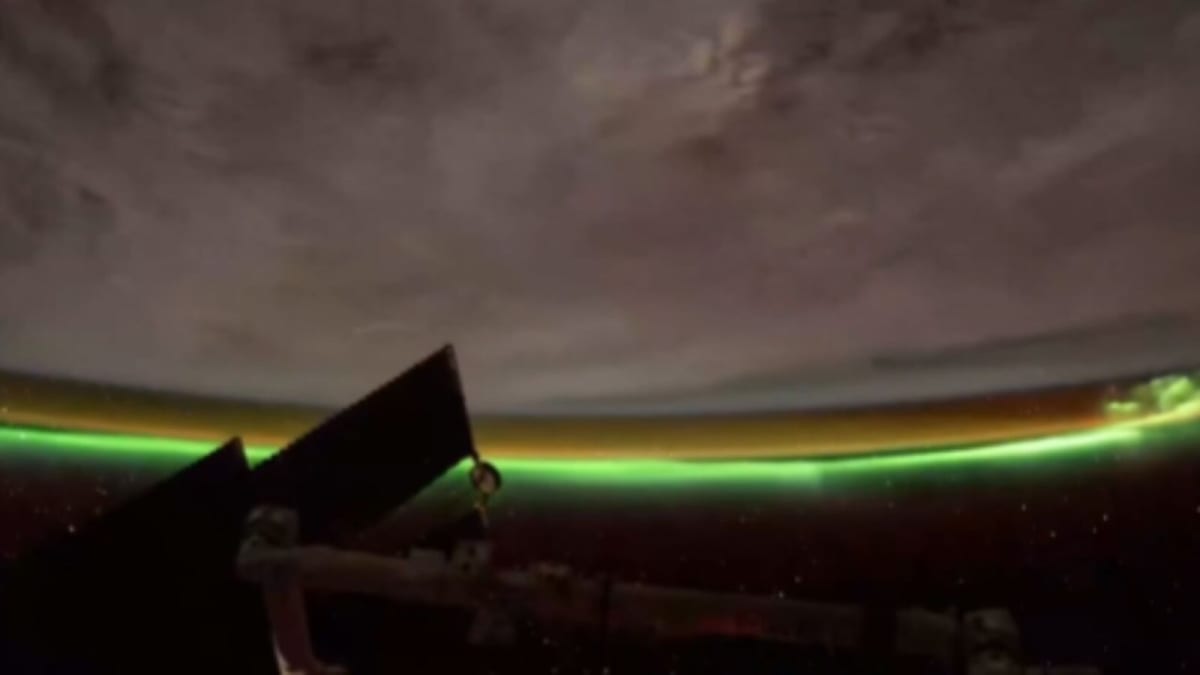
Breathtaking Aurora Timelapse Shows the Beauty of Earth From Space
June 2026: NASA has amazed space enthusiasts around the world by sharing a mesmerizing timelapse video of brilliant green auroras glowing above Earth as seen from the International Space Station (ISS).
The breathtaking footage showcases streams of bright green light moving across the planet’s curved horizon, offering a rare and extraordinary perspective of one of nature’s most beautiful phenomena. Captured from orbit, the video also reveals parts of the International Space Station as it travels hundreds of kilometers above Earth.
The incredible view highlights not only the beauty of our planet but also the remarkable capabilities of modern space exploration.
What Causes Auroras? The Science Behind the Green Lights
According to NASA, auroras are created when charged particles released by the Sun travel toward Earth and interact with the planet’s magnetic field and atmosphere.
During this interaction, energetic particles collide with gases in the upper atmosphere, releasing energy in the form of colorful lights. These displays can appear in different colors, including green, purple, pink, and red, depending on the type of atmospheric gases involved and the altitude at which the collisions occur.
The green aurora seen in NASA’s latest footage is one of the most common and recognizable forms of the phenomenon.
A Unique View From the International Space Station
The International Space Station provides astronauts with a unique viewpoint that cannot be experienced from the ground. Orbiting Earth at approximately 400 kilometers above the surface, the ISS allows crew members to witness natural events such as auroras, thunderstorms, and sunrises from a completely different perspective.
NASA described the space station as a symbol of global cooperation, where astronauts from different countries live and work together to conduct scientific research and advance humanity’s understanding of space.

Dany is a business journalist with Annuity Outlook Magazine, with over 16 years of experience across print, digital, and wires. He covers business, technology, policy, and corporate developments, with a focus on in-depth reporting and analysis. Over the years, he has worked across multiple editorial platforms. Skilled in content creation, editing, proofreading, and overseeing print layouts, his career spans multiple editorial platforms.